Stop copying data between systems. Let them talk to each other.
We connect your ERP, CRM, online shop, payment, shipping and accounting software through REST, GraphQL and webhook integrations. Written scope, written quote, error monitoring and full source code handover.
EU legal entity · GDPR-compliant · intra-EU VAT invoicing
API & System Integration at a glance
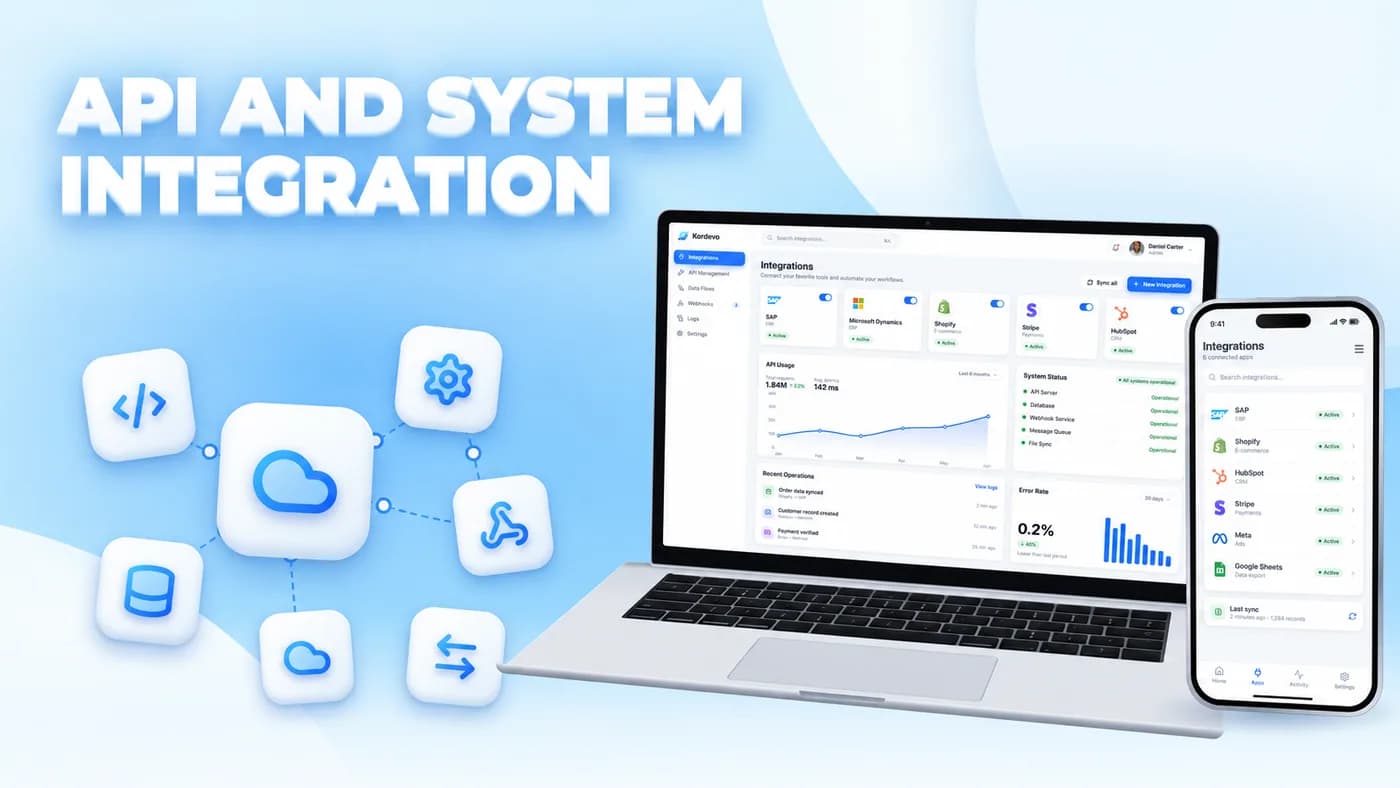
API integration is the work of connecting separate business systems, such as ERP, CRM, online shops, payment, shipping and accounting tools, so that they exchange data automatically and securely instead of through manual re-entry. Kordevo plans every integration with a written scope and a written quote, and the delivery date is set in the contract after scope approval. On delivery, you receive the source code, API documentation and all access credentials.
What the service covers
ERP and accounting integration
Customer accounts, invoices, stock and payment statuses synchronised automatically with your ERP or accounting software.
CRM integration
Web forms, shop orders and support requests land in the customer record without manual copying.
Marketplace and e-commerce integration
Stock, prices and orders across marketplaces and your shop managed from one master source.
Payment and shipping API integration
Payment results, refunds, shipping labels and tracking numbers written back to the order automatically.
E-invoicing and Peppol connections
Invoices sent through your e-invoicing provider or Peppol access point, with statuses returned to your system.
Custom API and middleware development
A middleware layer with queues, retries and monitoring that manages several systems in one place.
Legacy system integration and data migration
Secure database or file-based bridges for software without an API, plus planned data migration.
Why Choose Kordevo for API & System Integration?
As a business grows, it adds separate software for accounting, sales, shipping, marketplaces and customer relationships. When these systems are not connected, the same order, invoice or stock figure is entered several times by hand, which leads to errors, delays and reports that never quite match. Good integration is not about connecting everything to everything. It starts by deciding which system is the source of truth for each type of data, and then moves data only in the direction and at the frequency the business actually needs. Where it makes more sense to bring scattered data into one application, we also look at custom CRM and ERP software with you.
Every integration project begins with a data flow map. Together we document which systems will be connected, how fields map between them, whether data should move instantly via webhooks or in scheduled batches, and what should happen when a connection fails. The result is a written scope and a written quote, and the delivery date is set in the contract after scope approval.
We choose the architecture to fit the problem. A simple sync between two systems may only need a direct connection; once several systems are involved, we build a middleware layer that manages all flows in one place. We work with REST, GraphQL, SOAP, webhooks and SFTP or CSV exchanges, and we use message queues, automatic retries and idempotent processing so that records are not lost or duplicated. For legacy software without an API, we build secure bridges based on database access or file exchange. For shops with heavy product and order traffic, we often plan the integration together with the e-commerce platform itself.
Security is the most critical part of any integration. We use OAuth 2.0 and narrowly scoped API keys, and store secrets in an encrypted vault rather than in code. All traffic is encrypted with TLS, and personal data is masked in logs. Our work follows the OWASP API Security Top 10, we sign a GDPR-compliant data processing agreement, and on request the integration layer is hosted on servers inside the European Union. This matters in particular for companies selling to customers in Germany and the Netherlands.
Integrations are first tested against realistic scenarios in a staging environment and then rolled out to production step by step. On delivery, you receive an error monitoring dashboard, alerting, OpenAPI documentation and the complete source code. Throughout the project we send weekly progress reports. After launch, our maintenance service tracks version changes in third-party APIs and keeps your integrations up to date. If you want AI-assisted workflows on top of your integrations, we can plan them together with our AI automation service.
Technologies We Use
Let's Get Started
The first consultation is free. Written quote within 24 hours for clearly scoped work.
Get Free QuoteOr call us now: +90 552 944 24 34
Direct Connection or Central Middleware?
The right architecture depends on how many systems you connect and how you plan to grow. The table compares the two common approaches.
Best suited to
- Direct (point-to-point) integration
- A simple, single-purpose sync between two systems
- Central middleware layer
- Three or more systems with data flowing in several directions
Setup
- Direct (point-to-point) integration
- Fewer components, faster to go live
- Central middleware layer
- Requires planning and infrastructure setup
Adding a new system
- Direct (point-to-point) integration
- New connections must be written for each system
- Central middleware layer
- A new system is added at one point
Error monitoring
- Direct (point-to-point) integration
- Each connection is monitored separately
- Central middleware layer
- All flows monitored in one dashboard, with queued retries
Maintenance
- Direct (point-to-point) integration
- Grows more complex as connections multiply
- Central middleware layer
- Changes are managed centrally
What Drives the Cost of an API Integration?
Integration cost is driven by the systems and the complexity of the data flows, not by screens. Our quotes are built on these factors.
Number of systems
How many applications are connected and whether a direct link or a middleware layer is needed.
Data flows
One-way or two-way sync, real-time or scheduled transfer, and the complexity of field mapping.
Quality of third-party APIs
The state of the documentation, sandbox access and the provider's limits.
Legacy systems and migration
Building bridges for software without an API and cleaning and moving historical data.
Error handling and monitoring
Requirements for queues, retries, alerting and the monitoring dashboard.
Written quote
For clearly scoped work we send a written quote within 24 hours.
Which companies benefit the most?
Online retailers and marketplace sellers
Businesses selling on Amazon, eBay, Shopify or WooCommerce that want stock, prices and orders managed from one source of truth in their ERP.
Companies running many separate tools
Teams re-typing the same customer, order and invoice data across CRM, accounting, shipping and email tools every day.
Businesses tied to a legacy system
Companies that rely on an older desktop application or database without an API and need it connected to modern tools without disrupting operations.
API & System Integration: how we work
Brief
We define your needs, goals and constraints. We produce a written project summary and timeline.
Design
Wireframe and high-fidelity Figma design. Approval before development begins.
Development
Sprint-based development. You can see a working version every two weeks.
Testing
Functional tests, performance checks, mobile compatibility and SEO validation.
Launch
Live deployment, Google Search Console setup, handover of source code and accounts, then ongoing maintenance.
API & System Integration frequently asked questions about
Common questions about our process, scope, delivery timeline and way of working.
The price depends on the number of systems involved, whether data flows one way or both ways, the quality of the target APIs and your error-handling requirements. The first call is free. Once the scope is clear, we send a written quote within 24 hours for clearly scoped work, and nothing outside that scope is charged without your approval.
Last updated:
Where we work
We work remotely with businesses across Europe: video calls, phone and email, a written scope, weekly progress reports and a delivery date set in the contract.
Let's Talk About Your Project
The first consultation is free. For clearly scoped work, you receive a written quote within 24 hours. Tell us your idea and we'll map out the next steps.
- Written quote
- Contract-backed delivery
- English-language communication