How to Start Implementing AI in Your Business
A practical AI implementation roadmap for European SMEs: how to choose the first process, when an off-the-shelf tool is enough, how to connect AI to your CRM, measure ROI and stay GDPR and AI Act compliant.
Summary
A practical AI implementation roadmap for European SMEs: how to choose the first process, when an off-the-shelf tool is enough, how to connect AI to your CRM, measure ROI and stay GDPR and AI Act compliant.
The best place to start with AI implementation is one well-defined business process, not a tool. Pick a repetitive task that consumes your team's time, measure what it costs today, and test AI in a short pilot where a person approves every output. Scale up or integrate with your CRM or ERP only after the pilot shows a measurable result.
Implementing AI does not mean buying chat licences. It means changing a specific process so that an AI model does part of the work: classifying, extracting data, summarising or drafting a reply. A person remains accountable for the result.
According to Eurostat, 19.95% of EU enterprises with 10 or more employees used AI technologies in 2025, compared with 55.03% of large enterprises.
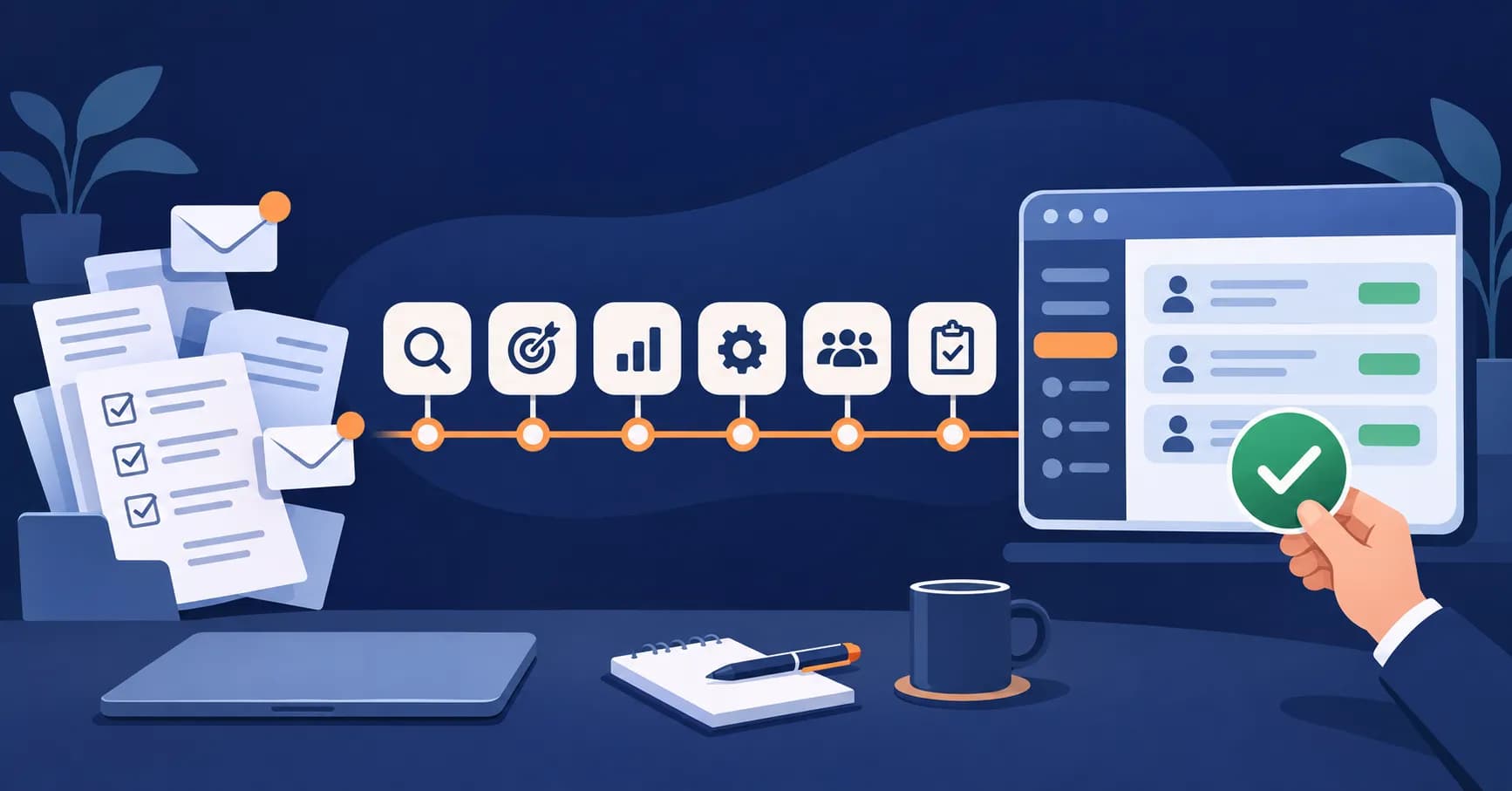
A six-step AI implementation roadmap
- Inventory your tasks. Ask department heads to list repetitive work: shared inbox triage, retyping data from documents, preparing quotes, reporting. Also find out which AI tools employees already use on personal accounts. This "shadow AI" is a data-leak risk.
- Choose a pilot process using the scoring framework below.
- Measure the baseline. Cases per month, minutes per case, error rate, response time.
- Choose the technical approach: an off-the-shelf SaaS tool, an AI feature inside a system you already use, or a custom integration.
- Run a pilot with a human in the loop. Narrow scope, a few weeks, every output approved by an employee, corrections logged.
- Evaluate and decide. Compare results with the baseline, then scale, adjust or stop.
Which process to automate first
Score each candidate process from 1 to 5 on five criteria:
- Volume: how often the task occurs.
- Repeatability: whether the rules can be written down and good outputs shown as examples.
- Data readiness: whether the inputs are digital and accessible, such as emails, PDFs or CRM records.
- Measurability: whether time, errors or response speed are easy to count.
- Error tolerance: how serious a mistake would be for customers, finances or people's rights; a higher score means lower risk.
Start with the highest total, but never with a process scoring below 3 on error tolerance. Strong candidates include ticket or email triage, document data extraction, draft customer service replies and sales-note summaries. Weak first projects are decisions about hiring, employee evaluation or the creditworthiness of individuals, because the EU AI Act lists these uses as high-risk (Annex III).
We describe more candidates in 7 business processes small businesses can automate with AI.
Example: support tickets connected to a CRM
This scenario is illustrative, not a real client case. A B2B service company receives a steady flow of support requests by email and web form. Today, an agent reads each one, looks up the account in the CRM and routes it manually.
After implementation:
- AI reads the incoming request and identifies its type and urgency.
- The workflow finds the customer, contract and recent orders in the CRM via API.
- A ticket is created with a category, priority and a short summary.
- For routine questions, AI drafts a reply using the account data and the internal knowledge base.
- An agent approves or edits the draft. Nothing reaches the customer without approval.
The same pattern works for purchase orders, delivery notes or contracts. For structured e-invoices, a classic integration is usually enough; AI adds most value on unstructured documents.
Off-the-shelf AI tool or custom integration
SaaS tools
AI assistants in office suites, AI features built into CRMs, ready-made chatbots. They offer a fast start, low entry cost and no infrastructure to run. The trade-offs: you adapt your process to the tool, integration with your own systems is limited, and the vendor processes your data. Before rollout, check the processing agreement, data location and whether your data trains models.
Custom integration
An AI model called via API and connected to your CRM, ERP, mailbox or document repository. AI then works inside your process, with your permissions and audit logs. The price is a higher upfront effort and ongoing maintenance.
How AI connects to an existing CRM or ERP
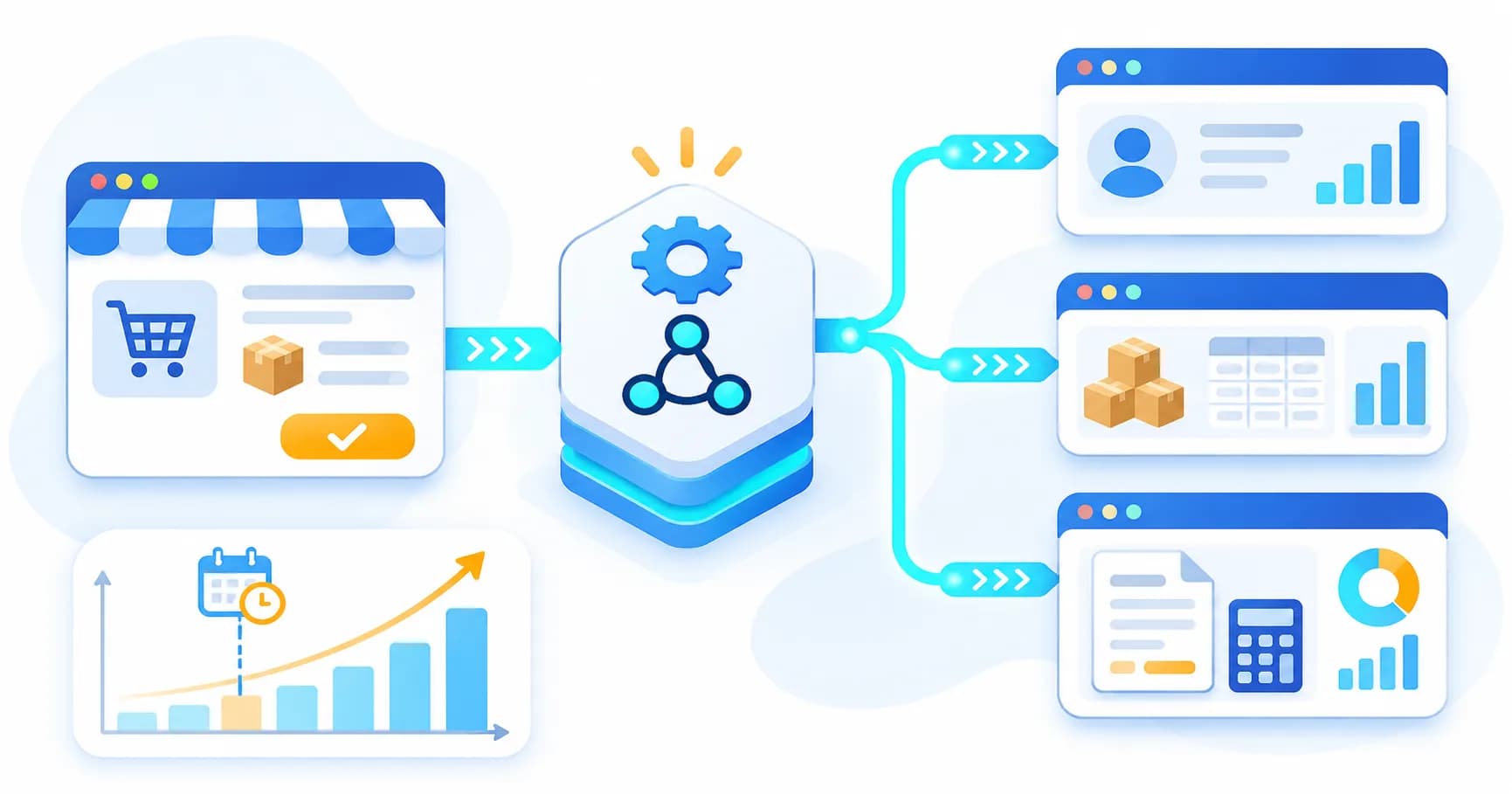
Most modern systems expose an API or webhooks. An event, such as a new email or document, triggers a workflow that fetches the required data, sends it to the model and writes the result back to the CRM as a draft or task. Start with read-only access, pass only the fields the model needs and log every call. Legacy systems without an API need a middleware layer, which often extends the timeline. This is the scope of our API and system integration work and, where the current system no longer fits, CRM and ERP software.
A small business rarely needs custom AI software on day one. Start with an off-the-shelf tool and clear rules, then automate between existing systems, and build custom only when the process is core, volume is high and ready-made tools cannot meet your data or security requirements.
What drives the cost of AI implementation
Prices depend on scope, so we quote no figures here. When budgeting, include:
- process analysis and data preparation,
- licences or model usage fees, often billed by the volume of text processed,
- integration work with CRM, ERP and email,
- testing, the pilot and team training,
- maintenance: quality monitoring, updates and changes to vendor APIs,
- the staff time spent reviewing AI outputs.
Integrations, data quality and security requirements drive most budget differences.
How to calculate business value and ROI
- Process cost before = cases per month × minutes per case × hourly labour cost ÷ 60.
- Process cost after = cases × review and correction minutes × hourly cost ÷ 60 + monthly AI tool costs.
- Net monthly benefit = step 1 minus step 2.
- Payback period = one-off implementation cost ÷ net monthly benefit. If the net monthly benefit is zero or negative, no payback period can be calculated.
- First-year ROI = (12 × net monthly benefit − one-off cost) ÷ one-off cost × 100%.
A hypothetical example: 800 tickets a month at 5 minutes each is about 67 hours of work. If review takes 2 minutes after implementation, about 27 hours remain, and you value the 40 recovered hours at your own rate. Track quality alongside time: the share of drafts accepted without edits, error counts and first response time.
Data security, GDPR and the EU AI Act
GDPR
When AI processes personal data about customers or employees, the GDPR applies: a lawful basis and data minimisation, a processing agreement where the vendor processes data on your behalf (Article 28), and a data protection impact assessment (Article 35) where processing is likely to result in high risk. Article 22 restricts decisions based solely on automated processing that produce legal or similarly significant effects. Recommended practice: AI prepares, a person decides.
The EU AI Act
Regulation (EU) 2024/1689 has applied in general since 2 August 2026. Most prohibited practices have applied since February 2025, and the rules for high-risk use cases listed in Annex III apply from 2 December 2027, following the AI Omnibus simplification package (European Commission). For a typical SME using AI as a deployer, transparency obligations matter most. Article 50 requires systems that interact directly with people to inform them they are dealing with AI unless this is obvious. Formally this is the provider's duty, but a company deploying a chatbot should check it is met, and one that builds its own may itself be the provider.
Human oversight in practice
Beyond legal duties, it is good practice to appoint a process owner, write down AI usage rules, train the team and keep a register of tools in use. This article is not legal advice; for sensitive processes, consult a lawyer or your data protection officer.
Common implementation mistakes
- Starting with a tool instead of a problem. Licences bought without a process often go unused.
- No baseline. After the pilot, nobody can say whether it was worth it.
- Automating a messy process. AI will speed up the mess, so fix the steps first.
- No rules for staff. Company data ends up in personal accounts.
- Decisions without human review. This creates legal and reputational risk.
- No business owner. A project run only by IT loses touch with the real process.
Checklist before you start
- We have one pilot process and a named owner.
- We know the volume, handling time and error rate before the change.
- We know what data AI will process and whether it includes personal data.
- If the vendor processes personal data for us, a processing agreement is in place and the data location is known.
- We have decided who approves AI outputs.
- We have success criteria and a date for evaluating the pilot.
- Employees know the rules for using AI tools.
- We know whether customers must be told they are interacting with AI.
How Kordevo supports first AI projects
Kordevo is an EU software company based in Łódź, Poland, that helps businesses move from choosing a process to AI automation and, when ready-made tools are no longer enough, custom AI software development. Planning a customer-facing assistant? See our practical guide to AI and chatbots for businesses.
Tell us which process you want to improve and book a consultation; together we will assess whether an AI pilot makes sense and how to measure it.
Frequently Asked Questions
How long does AI implementation take?
A pilot with an off-the-shelf SaaS tool can start relatively quickly, while projects that integrate with a CRM or ERP typically take from several weeks to a few months. The timeline depends on data quality, the number of integrations, API availability, security requirements and how quickly the company makes decisions.
Does a small business need custom AI software?
Usually not at the start. A small business can begin with an off-the-shelf tool and clear usage rules. Custom software makes sense when the process is core to the business, volumes are high, and ready-made tools cannot connect to its systems or meet GDPR requirements.
How can a company measure AI implementation success?
Before the pilot, measure case volume, handling time, error rate and response time. After the pilot, compare the same metrics and add the share of AI outputs accepted without edits plus tool costs. The difference lets you calculate the payback period and ROI.
Can employees paste customer data into ChatGPT or similar tools?
The GDPR does not ban such tools, but it requires a lawful basis, data minimisation and, where the vendor acts as a processor, a processing agreement. We therefore recommend company-managed accounts with a suitable agreement, a known data location and model training on your data switched off, rather than employees' personal accounts. Write these rules into an internal AI policy.
Which business process should be automated first?
One that is frequent, repetitive, based on digital data, easy to measure and low-risk if something goes wrong. Good examples are email or ticket triage, data extraction from documents and draft customer service replies that an employee approves.